Showing posts with label BBA Challenge. Show all posts

Tuesday, February 14, 2012

BBA White Bread, variation 3


After baking bread more and less steadily over the past few years, one thing that I've learned (and relearned): bread is forgiving.  It's not usually difficult, and it rarely requires much hands-on work, but there is a fair amount of time waiting for the yeast to do its work raising the dough.  This process can be manipulated, and a simple bread can be baked in increments over a day or two rather than in one long session.

Such was this case with this bread in my kitchen.  It was kind of a busy day when I tackled this bread, and and the process of making it took me from 10am in the morning to 1am the next morning.  It became an exercise in me waiting for the dough and the dough waiting for me!


n.o.e.'s notes:

-  I made full recipe of this bread.  Peter Reinhart's Bread Baker's Apprentice has three different variations of White Loaf Bread.  I baked Variation 3 first because I had milk on hand that I needed to use up. [I later baked Variation 2, using buttermilk, but have skipped Variation 1, which calls for powdered milk. At some point I might revisit that formula]

-  This recipe starts with a sponge of warm milk, flour, and yeast.  My sponge was a bit stiff, so I probably should have added more liquid.  It never bubbled but it did swell.  After more than an hour, I added the other bread ingredients, mixing the dough first in the food processor and then finishing kneading it by hand.  It was looking as though the dough would need some more liquid, but when I added the fat to the recipe - I melted the butter so it would be liquid - the dough was perfect in texture.

-  My schedule didn't permit me to continue with the bread in one continuous session, so I put the dough in a rising bucket and straight into my fridge.  The dough was warm, and it rose as it cooled in the fridge - when I checked on it later I saw that it had nearly doubled!

-  I deflated it the dough intentionally and let it warm to room temperature and rise as it warmed.  Once the dough had doubled, I divided it then formed the loaves, placed it into bread pans and parked them back in the fridge while I attended a meeting.

-   There really wasn't that much dough.  I weighed it, and a full recipe of the bread - supposed to be 2 loaves - weighed just a bit more than the weight of one loaf in my standby Milk Bread recipe, so I measured out the amount of dough that goes into the typical milk loaf - 450g, and placed in a smallish loaf pan (the size I use for the milk loaf usually - it's about 7x3").  The remainder - about 575 g, went into the 8.5x4.5" pan.

-  After the meeting I pulled the pans out of the fridge, let it warm and rise.  I could have left the bread refrigerated overnight and baked the next morning.  Retarding the dough helps develop the flavor, so baking in an interrupted fashion always has a silver lining!

-  Before popping the bread into the oven, I slashed the tops with the lame and rubbed some oil into the slash.

-  Even with adjusting my pan sizes, the loaves were still pretty petite.  Next time I'd bake this recipe as one loaf in one larger (9x5) pan, or as sandwich rolls.


the verdict:

The bread had a close crumb, moist, soft, and golden. It was sweet and eggy in flavor. We used it for toast, but I think it's better suited for sandwiches, either in loaf or in roll form.

Monday, January 16, 2012

Pain a l'Ancienne {bba}


It's been quite a while since I've posted a hearth bread on this blog.  Truth be told, I don't bake many hearth loaves; most of the bread consumed in our house is in toast form, so I'm usually baking bread in loaf pans to be sliced and toasted for breakfast.  And (maybe because I make so many sandwich/toast loaves) I'm not very comfortable baking hearth loaves. 

At any rate, Peter Reinhart's book The Bread Baker’s Apprentice has a hefty share of free-form loaves, so I inevitably get some practice as I make my way through the book as part of the Bread Baker's Apprentice Challenge - an endeavor that I am still erratically pursuing, although I will be skipping the part of the challenge that deals with sourdough starters.  It's a bit too much of a challenge for me right now!  Anyway, enough digression. 

The next bread from BBA is the Pain a l'Ancienne, a venerable baguette in which all of the flavor of the wheat is unlocked via a process of delayed fermentation at controlled temperature, ie, using cold water and storing the dough in the refrigerator for a time.

Although it sounds pretty complicated, if you follow Reinhart's directions it comes together fairly easily.  I'm still not very confident in my bread-shaping abilities, but my loaves turned out decently and I have to say the aromas wafting through my kitchen as the bread baked were tantalizing!

n.o.e.'s notes:

-  I made half recipe of this bread, which yielded three baguettes.

-  I have to admit that I didn't keep many notes when I was making this bread, but you can see step by step photos of how this bread is made on this post by BBA Challenge founder Nicole.  Members of the Challenge are asked to not post the recipe.

-  The crust of my bread developed a beautiful golden color, but the crumb was a bit denser than I would have liked - some big holes would have been lovely!

 I ordered this cool bamboo cutting board here after hearing about it from Jaden of Steamy Kitchen
the verdict:

I served this bread to my to book group, and it was a resounding hit with everyone.  I was smitten with the chewiness and flavor of this bread; in fact it might be the best loaves that I've ever baked!
If I had my druthers, I would have preferred large airy holes inside, but who can quibble when the bread tastes this good?

Sunday, July 17, 2011

BBA Slow & Steady: Mulitgrain Bread Extraordinaire Roundup

Although I am dreadfully behind on posting our results, the bakers of the Slow and Steady subgroup of the BBA Challenge are still working their way through the book. Several of them have pressed on into the sourdough section and are currently nearing the end of the book The Bread Baker's Apprentice!

Their progress has inspired me to pick back up and post the next in the series of Slow and Steady roundups. We all baked the Multigrain Bread Extraordinaire sometime back in 2010, but better late than never, right? Here is how the bread, which is famous for turning out extraordinary toast, turned out in our kitchens:

^^^^^^^^^^^^^^^^^^^^^^^^^^^^^^^^^^^^^^^^^^^^^^^^^^^^


Leslie of Lethally Delicious baked this recipe as rolls, and found the flavor to be "rich and deep." Read Leslie's post: BBA - Multigrain Bread Extraordinare


^^^^^^^^^^^^^^^^^^^^^^^^^^^^^^^^^^^^^^^^^^^^^^^^^^^^^^^


The fourth time's a charm, and after a few failed attempts at making the soaker for this bread, Jessica of The Singleton in the Kitchen, with brown rice on hand, found the bread easy enough to make. As for the taste: she didn't find it to be "bread nirvana" but she reports that the toast was a pleasant way to begin her day. Her post: BBA S&S: Loafin' Around

^^^^^^^^^^^^^^^^^^^^^^^^^^^^^^^^^^^^^^^^^^^^^^^^^^^


Natalia of Gatti, Fili e Farina
loved this bread so much that she got hungry for some when she was writing her post.
her post: BBA Slow and Steady: Multigrain Extraordinaire

^^^^^^^^^^^^^^^^^^^^^^^^^^^^^^^^^^^^^^^^^^^^^^^


Kayte of Grandma's Kitchen Table thought that her bread wasn't much in the looks department (I beg to differ!) but loved the taste. Her family enjoyed this bread as toast, grilled cheese and sandwiches. Her post: BBA: Mulitgrain Bread Extraordinaire

^^^^^^^^^^^^^^^^^^^^^^^^^^^^^^^^^^^^^^^^^^^^^^^


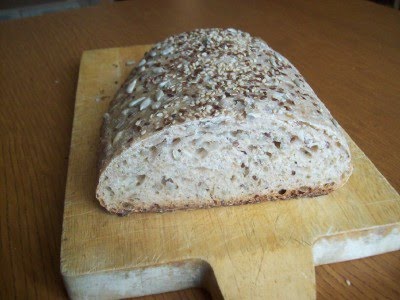
I baked this bread and posted it before the Bread Baker's Apprentice Challenge. In fact, this bread is what convinced me to purchase Reinhart's book (I baked the bread from versions of the recipe I found online) See my post here. The bread makes such great toast that it's worth keeping little bits of cooked brown rice and other grains in the freezer so that the bread can be baked on short notice.